
Introduction
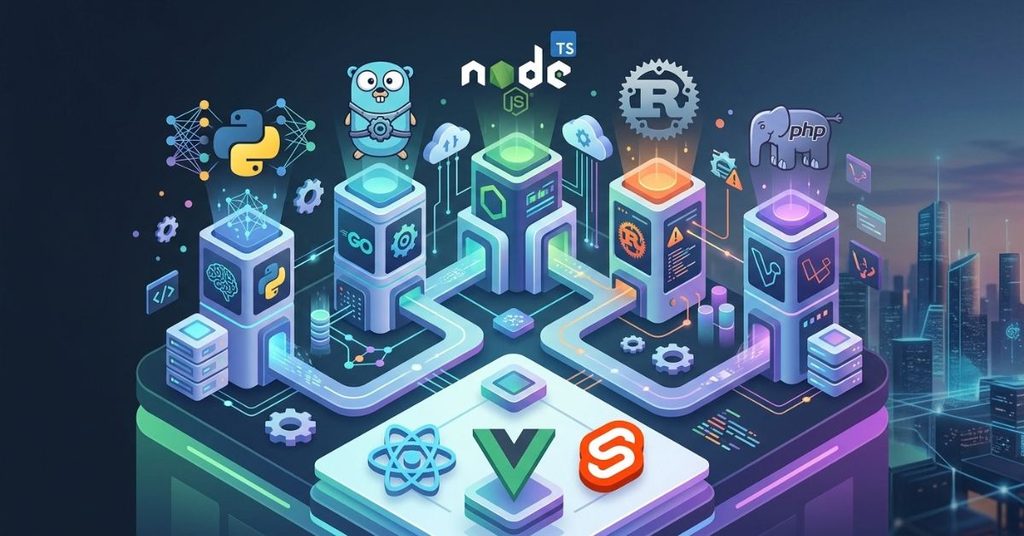
Choosing among the top web programming languages in 2026 feels harder than it used to. Five years ago, most teams picked between three or four options. Now AI tooling, WebAssembly, and edge computing all pull the decision in different directions.
This guide breaks down the languages that actually matter this year. It covers backend, frontend, and full-stack choices. Additionally, you’ll discover how to choose the right one for your project using a practical framework.
Why the 2026 Landscape Looks Different
Three shifts changed how teams choose languages this year.
AI-native tooling matters now. Frameworks that integrate cleanly with LLM APIs and vector databases pull ahead. Python and TypeScript benefit the most from this shift.
WebAssembly moved from experiment to production. Rust and Go both compile to Wasm well. Teams use this for heavy client-side computation that used to require a native app.
Edge computing changed backend priorities. Cold-start time matters more than raw throughput for many teams now. Runtimes like Go and Bun handle this better than older, heavier stacks.
Keep these three shifts in mind. In most cases, they explain the rankings below.
Top Backend Languages for Web Development in 2026
Python
Python stays dominant for backend web development. FastAPI pushed Python into high-performance territory that Django alone never reached. Python’s real strength in 2026 is its AI ecosystem; most LLM tooling, embeddings libraries, and ML pipelines ship Python-first.
Best for: AI-integrated apps, data-heavy platforms, startups that need to move fast.
Go
Go keeps growing in backend roles, especially for microservices. Its compiled binaries start fast, use little memory, and handle concurrent requests well. Teams building infrastructure-heavy platforms, payment systems, real-time services, and high-traffic APIs lean on Go for this reason.
Best for: Microservices, high-concurrency APIs, infrastructure tooling.
Node.js (TypeScript)
Node.js remains the default for teams that want one language across the stack. TypeScript adoption inside Node projects is now close to universal for anything beyond a small prototype. Strict typing catches errors before they hit production, which matters more as codebases grow.
Best for: Full-stack JavaScript teams, real-time apps, startups prioritizing developer speed.
Rust
Rust adoption in web backends grew steadily, though it stays a minority choice. Teams pick it for performance-critical services, payment processing, low-latency APIs, systems where memory safety without a garbage collector matters. The learning curve stays steep, so most teams reserve Rust for specific high-stakes components rather than the whole stack.
Best for: Performance-critical services, systems programming inside a web stack.
PHP
PHP still powers a large share of the web, largely through WordPress and Laravel. Modern PHP (8.x) performs far better than its reputation suggests. Laravel’s ecosystem keeps PHP relevant for teams building content-driven sites and traditional web apps quickly.
Best for: Content platforms, rapid CRUD apps, teams with existing PHP infrastructure.
Top Frontend Languages and Frameworks
TypeScript now dominates frontend development. Plain JavaScript hasn’t disappeared, but most serious frontend teams write TypeScript by default. It catches bugs at compile time and makes large codebases easier to maintain.
For teams using AI-assisted development workflows, vibe coding mobile apps can also help turn natural-language ideas into working mobile application code, especially when developers combine AI generation with proper testing and architecture.
React remains the most-used frontend library, though Vue and Svelte both hold strong niches: Vue for teams that want a gentler learning curve, Svelte for teams that prioritize smaller bundle sizes and simpler reactivity.
Backend vs. Frontend: A Quick Comparison Table
| Language | Primary Role | Strength | Best Fit |
| Python | Backend | AI/ML integration, readability | Data & AI-driven apps |
| Go | Backend | Speed, low memory, concurrency | Microservices, infra |
| Node.js/TS | Full-stack | One language, huge ecosystem | Startups, real-time apps |
| Rust | Backend | Performance, memory safety | High-stakes, low-latency systems |
| PHP | Backend | Fast CRUD development | Content sites, existing PHP apps |
| TypeScript | Frontend | Type safety, tooling | Any serious frontend project |
How to Choose a Language for Your Project
Don’t pick a language because it’s trending. Pick it based on your actual constraints.
Ask these four questions first.
- What’s your team’s existing skill set? Switching languages costs more than most teams expect.
- How much traffic will you actually see? Most projects never need Rust-level performance.
- Does AI integration matter to your product? If yes, Python or TypeScript usually wins.
- What’s your deployment target? Edge functions favor lightweight, fast-starting runtimes.
A small internal tool doesn’t need the same stack as a payments platform. Don’t follow the hype cycle; match the tool to the job.
WebAssembly and What It Changes

WebAssembly lets code written in Rust, Go, or C++ run in the browser at near-native speed. In 2026, this matters for a specific set of use cases: video editing in-browser, complex data visualization, games, and CAD-style tools.
Most teams still don’t need Wasm. If your app is a standard CRUD web app or dashboard, JavaScript or TypeScript handles it fine. Reach for Wasm only when the browser genuinely needs to do heavy computation.
Common Mistakes Teams Make When Choosing a Stack

- Chasing trends over fit. A language being popular doesn’t mean it fits your project.
- Underestimating hiring difficulty. Niche languages can leave you short on candidates.
- Ignoring the AI angle too late. Retrofitting AI features onto a stack that doesn’t support them well gets expensive.
- Over-engineering for scale you don’t have yet. Most startups don’t need Go-level performance on day one.
FAQs
How should beginners learn a language in 2026?
Python. It reads close to plain English, has huge learning resources, and applies directly to both web development and AI work.
Is JavaScript still worth learning if TypeScript dominates?
Yes. TypeScript compiles down to JavaScript, and you’ll still read plain JavaScript in older codebases and many libraries.
How should I learn backend development in Go versus Rust?
Learn Go first if you want a shorter learning curve with strong performance. Learn Rust if your work involves systems programming or you need maximum performance and memory control.
Does PHP still make sense to learn in 2026?
Yes, especially if you want to build content sites quickly or work with WordPress/Laravel-based systems, which still run a large share of the web.
Is WebAssembly necessary for most web developers?
No. Most web development doesn’t need it. It matters mainly for performance-heavy, browser-based applications.
Conclusion
The top web programming languages in 2026 serve different needs. Python fits AI-driven and data-heavy apps, Go fits lean and fast backend services, TypeScript works across frontend and full-stack development, Rust suits performance-critical systems, and PHP remains useful for content-driven platforms.
Pick based on your team, your traffic, and your product’s real needs, not the loudest trend. That decision matters more than any ranking list.

I am Qasim Ali, a technology enthusiast passionate about exploring the latest innovations shaping our digital world. With 5+ years of experience in technology and digital trends, I share practical insights on AI, software, hardware, cybersecurity, programming, and emerging technologies. Through Techvens, my goal is to simplify complex technology and help readers stay informed, confident, and ahead in the fast-moving tech world.