
Introduction
Every industrial site runs on risk. A forklift takes a wrong turn. A contractor skips a lockout step. A chemical drum leaks two millimeters more than it should. None of these events wait for a spreadsheet to catch up.
HSE software exists to close that gap. It turns scattered paper logs and Excel trackers into one live system that captures incidents, audits, and environmental data the moment they happen.
This guide breaks down what HSE software actually means, how it works, and why organizations move to it faster than any other compliance investment.
What Does HSE Software Mean?
HSE software (Health, Safety and Environment software) manages an organization’s safety, health, and environmental compliance activities through a single digital platform. Some vendors call it EHS software; both terms describe the same category.
The system centralizes incident reporting, risk assessments, audits, corrective actions, and environmental monitoring. Instead of storing this information across email threads and shared drives, teams log it directly into the platform from a phone, tablet, or desktop.
At its core, HSE software answers three operational questions in real time:
- What happened, and where?
- Who owns the fix?
- Is the organization staying compliant with regulatory standards?
HSE Software vs. Traditional Compliance Tracking
A paper checklist tells you what happened last week. HSE software tells you what’s happening right now, and it flags the pattern before it becomes an incident.
Core Functions of EHS Management Software
Most platforms are built around four operational pillars. Each one solves a specific compliance problem that spreadsheets handle poorly.
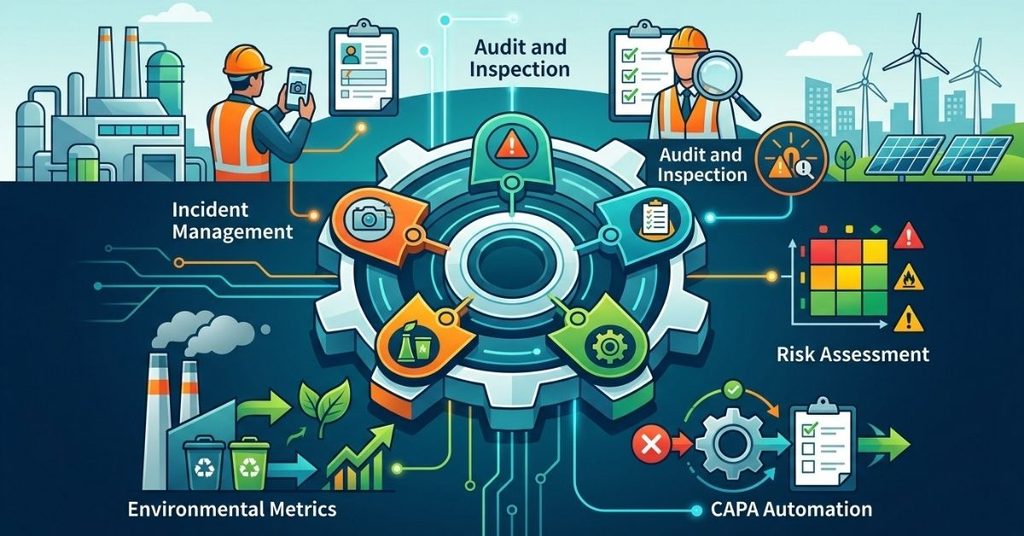
Incident Management and Reporting
Field workers report incidents and near-misses directly from a mobile app. They attach photos, tag the location, and route the report to the right supervisor instantly. This replaces the old cycle of paper forms sitting in a drawer until someone remembers to type them up.
Audit and Inspection Management
Safety managers schedule audits, assign checklists, and track findings inside the same system that logs incidents. This connection matters. When an audit finding links directly to a past incident, patterns become visible instead of buried in separate files.
Risk Assessment Tools
Digital risk assessment modules let teams score hazards using standard matrices (likelihood x severity) and update those scores as conditions change. A live risk register beats a static PDF that nobody reopens after the initial sign-off.
Corrective and Preventive Action (CAPA) Automation
CAPA automation is where most of the compliance value sits. When an audit or incident identifies a gap, the software assigns a corrective action, sets a deadline, and sends reminders until someone closes it out. No action gets lost in an inbox.
Environmental Metrics Tracking
Beyond safety, HSE platforms track emissions, waste disposal, water usage, and other environmental indicators required for ISO 14001 reporting. This data feeds directly into sustainability reports without a manual re-entry step.
How HSE Software Architecture Works

A well-built HSE platform follows a hub-and-spoke design. Four core modules feed data into one central analytics engine:
- Incident Reporting captures field-level events as they happen.
- Audit Management logs scheduled and ad hoc inspection findings.
- Risk Assessment scores hazards and tracks mitigation status.
- Environmental Metrics records emissions, waste, and resource data.
Each module writes into the same database. The analytics engine then cross-references this data to surface leading indicators, so managers see risk building before it turns into a recordable incident, not after.
Cloud-based platforms extend this further by syncing data across every site in real time. A safety director in one country can see incident trends from a facility three time zones away without waiting for a weekly report.
A Framework for Assessing Digital Maturity
Organizations don’t adopt HSE software in one leap. Most move through recognizable stages, and knowing where you sit helps you plan the next step realistically.

Stage 1: Paper-Based Compliance. Incident forms, audit checklists, and permits exist on paper. Data lives in filing cabinets and takes days to compile for a single report.
Stage 2: Spreadsheet Tracking. Teams centralize records in Excel or Google Sheets. This improves visibility slightly but still relies on manual entry and offers no real-time alerts.
Stage 3: Integrated HSE Software. Incident reporting, audits, and CAPA workflows run on one platform. Data updates in real time, and reports are generated automatically instead of manually.
Stage 4: Predictive Safety Intelligence. The system uses historical and leading-indicator data to flag high-risk conditions before an incident occurs, shifting safety management from reactive to preventive.
Most mid-size industrial organizations sit somewhere between Stage 2 and Stage 3 today. Moving to Stage 3 is usually the point where measurable compliance gains show up.
Benefits of Environmental Health and Safety Software
The case for HSE software comes down to speed, accuracy, and defensibility during an audit.
- Faster incident response. Mobile reporting cuts the time between an event and a documented, escalated report.
- Fewer missed corrective actions. Automated reminders close the gap between “identified” and “resolved.”
- Audit-ready records. Regulators and internal auditors pull reports directly from the system instead of waiting on manual compilation.
- Better visibility across sites. Multi-site organizations compare performance and share lessons learned across locations.
- Reduced administrative burden. Safety teams spend less time on paperwork and more time on the floor.
Compliance: OSHA, ISO 14001, and ISO 45001
Most HSE platforms build compliance tracking directly around recognized standards, rather than leaving it to the user to interpret requirements manually.
OSHA compliance tracking software maintains OSHA 300, 300A, and 301 logs automatically as incidents get recorded, and calculates recordable rates without manual math.
ISO 45001 (occupational health and safety management) and ISO 14001 (environmental management) both require documented processes, internal audits, and continual improvement records. Digital platforms store this documentation in a structured, auditable format that satisfies certification body reviews far more efficiently than paper files.
Work permit systems, when integrated into the platform, ensure that permits for hot work, confined space entry, or excavation link directly to the risk assessments and training records required to issue them legally.
Comparison: Spreadsheet Tracking vs. Dedicated HSE Software

| Operational Criteria | Spreadsheet Tracking | Dedicated HSE Software |
| Incident logging speed | Manual entry, often delayed by hours or days | Real-time mobile capture |
| Data accessibility | Limited to one file, one device at a time | Cloud-based, accessible across sites |
| CAPA follow-up | Relies on manual reminders or email | Automated deadlines and escalations |
| Audit trail | Easy to edit without a record of changes | Locked, time-stamped audit trail |
| Regulatory reporting | Manually compiled for each submission | Auto-generated OSHA/ISO reports |
| Risk visibility | Static, reviewed periodically | Live risk register, updated continuously |
| Multi-site comparison | Requires manual consolidation | Built-in cross-site dashboards |
| Scalability | Breaks down past a handful of sites | Built for enterprise-wide deployment |
Illustrative Example: What a Digital Transition Can Look Like
To see how these pieces work together, consider a hypothetical mid-size manufacturing site moving from spreadsheet tracking to an integrated HSE platform.
Before the switch, incident reports sat in email threads for days before reaching the safety manager. Audit findings lived in a separate folder with no link back to past incidents. Corrective actions had no automated deadline, so several sat open for months.
After adopting a mobile-first HSE platform, field workers began logging incidents and near-misses directly from the shop floor. CAPA items received automatic deadlines and escalation reminders.
Audit findings started linking directly to related incidents, which let the safety team spot a recurring hazard around a specific machine line that spreadsheets had never surfaced.
Results like this vary significantly by facility, workforce size, and how consistently teams use the system. Organizations considering a similar transition should request verified performance data and references directly from software vendors, rather than relying on generic industry claims.
Worker Safety Performance Dashboards

Dashboards translate raw incident and audit data into indicators that management can act on. Two categories matter most:
Lagging indicators measure what already happened: recordable incidents, lost-time injuries, near-miss counts.
Leading indicators measure what’s likely to happen: overdue corrective actions, training completion rates, audit finding closure speed.
A dashboard that shows only lagging indicators tells you where you’ve been. Pairing it with leading indicators tells you where the organization is heading, which is the entire point of moving off spreadsheets in the first place.
How to Choose an HSE Software Platform
A short self-assessment helps narrow the field before evaluating vendors:
- How many sites need to report into one system?
- Does the workforce need offline mobile capture, or is a constant connection guaranteed?
- Which certifications (ISO 14001, ISO 45001) does the platform need to support out of the box?
- Does the CAPA workflow support automated escalation, or only manual reminders?
- Can the platform integrate with existing HR, training, or permit systems?
Answering these questions first prevents the common mistake of choosing a platform based on features that look impressive in a demo but don’t match the actual site workflow.
Software platforms can serve very different operational needs. For example, software-defined radio (SDR) platforms support communication and signal-processing applications rather than HSE compliance workflows. If you’re comparing technology categories, our guide to the SDR explains how SDR systems work and what beginners should consider before choosing one.
Frequently Asked Questions
What does HSE stand for in software?
HSE stands for Health, Safety, and Environment. HSE software manages compliance activities across all three areas from one platform.
Are HSE Software and EHS Software the Same Thing?
Yes. Both terms refer to the same category of software. EHS reorders the letters but covers identical functions: incident management, audits, risk assessment, and environmental tracking.
Does HSE software replace a safety manager?
No. It supports the safety manager by automating data collection, reminders, and reporting, but decision-making and site judgment still require a qualified person.
Can small businesses use HSE software?
Yes. Many platforms offer scaled-down plans for single-site operations, though the biggest efficiency gains tend to appear at multi-site or higher-headcount organizations.
How long does HSE software implementation typically take?
Implementation timelines vary by vendor and site complexity, ranging from a few weeks for a single site to several months for a multi-site enterprise rollout with legacy data migration.
Does HSE software help with ISO certification audits?
Yes. It maintains structured, time-stamped records of audits, corrective actions, and training, which certification bodies typically require during ISO 14001 and ISO 45001 reviews.
Conclusion
HSE software turns fragmented safety records into one connected system. It captures incidents in real time, automates corrective actions, and keeps compliance documentation audit-ready without last-minute scrambling.
Organizations still running on spreadsheets aren’t necessarily doing something wrong. They’re just working with tools that weren’t built for how fast field incidents actually move. Moving to a dedicated platform closes that gap, one incident report at a time.

I am Qasim Ali, a technology enthusiast passionate about exploring the latest innovations shaping our digital world. With 5+ years of experience in technology and digital trends, I share practical insights on AI, software, hardware, cybersecurity, programming, and emerging technologies. Through Techvens, my goal is to simplify complex technology and help readers stay informed, confident, and ahead in the fast-moving tech world.